When Kauri Tangohau was a kid, visiting whānau near where his Nan grew up in Whāngārā Mai Tawhiti, remnants from an Oscar-nominated film formed one of his playgrounds. Whāngārā, a small town roughly midway between Tolaga Bay | Ūawa and Gisborne | Tūranganui-a-Kiwa, was the setting of both the book (1987) and film (2003) Whale Rider. When the film crew finished their mahi, the fibreglass whales used to film the scenes of a mass beaching remained, and local kids repurposed them as a playground, clambering over their backs after church on Sunday mornings, or while their parents were busy at the marae. I loved hearing this story from Kauri (the ingenuity of tamariki in creating a unique playground from what they had to hand!) and it also feels emblematic of the ways that nationally- or internationally-prominent figures have been connected to this (currently) small town many times, over centuries. The stories that are shared within our inaugural 3D scan community church history, centred on Pātoromu in Whāngārā, connect the local to the national and the global again and again.
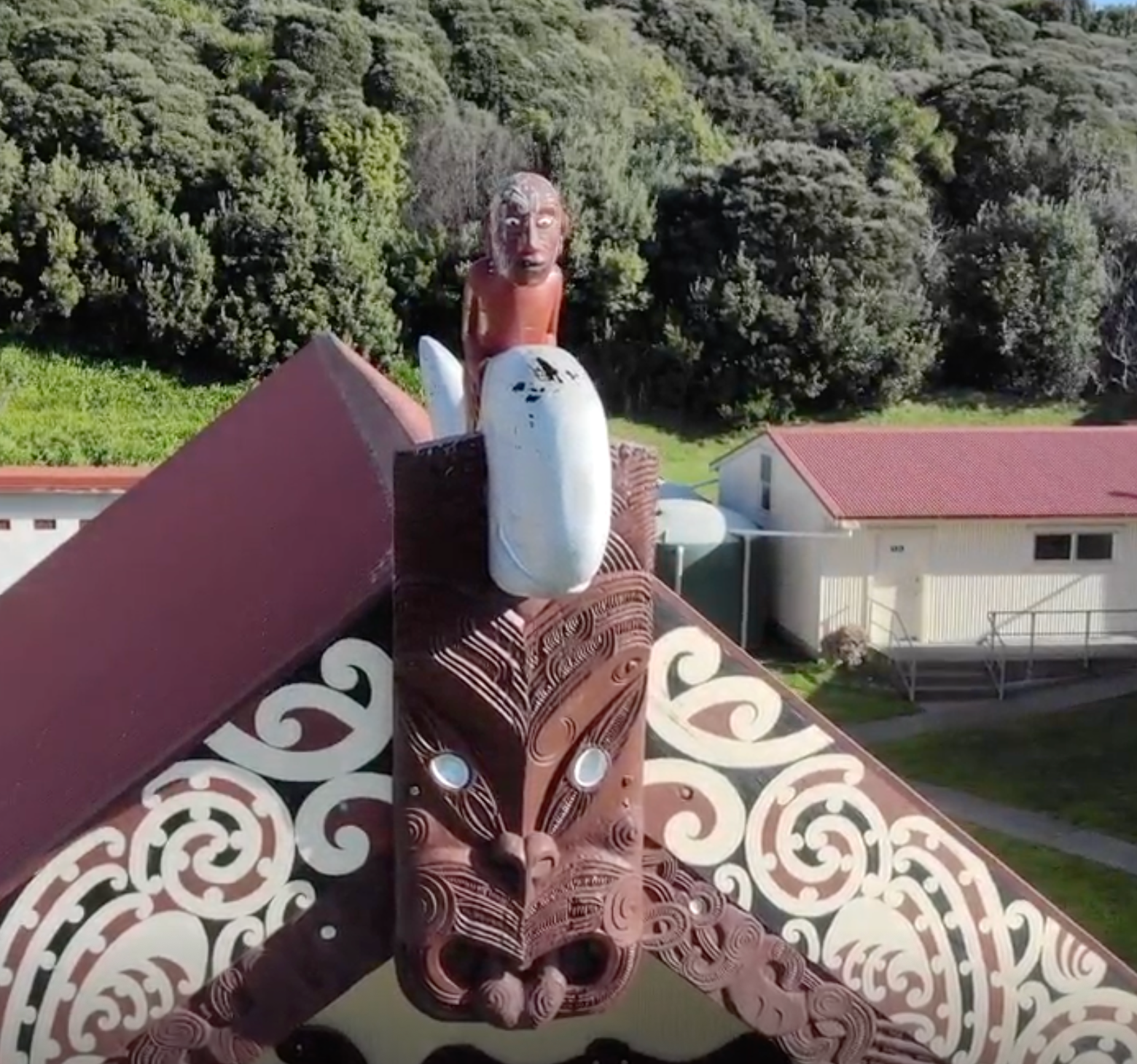
The earliest known connector of Whāngārā to distant places is Paikea, the ancestor of Ngāti Porou and Kai Tahu, who arrived in Aotearoa at Whāngārā on the back of a tohorā after his brother, Ruatapu, failed in his plan to kill him—a story recounted by Tā Derek Lardelli in one of the first videos you encounter in the 3D tour. Stories about Paikea (conflated with Kahutia-te-rangi in the kōrero tuku iho of some iwi) connected Aitutaki and Mangaia in the Cook Islands with Aotearoa; Paikea’s descendants connected Te Tairāwhiti to Te Waipounamu. The story of Paikea was also central to Witi Ihimaera’s novel Whale Rider, and the film adaptation of it. Paikea sits astride a whale at the pinnacle of Whitireia, one of two wharenui at Whāngārā marae, facing out to sea.
A young rugby-mad priest named William Brown Turei arrived as minister of Pātoromu Church in Whāngārā in 1952, his first parish placement after ordination. In coming to serve Pātoromu, he drew to a close a four-year-period in which this parish had no minister. Rev. Brown got married himself at Pātoromu to a local, Mihi King, he played rugby locally, and—as current minister, Rev. Hone Kaiwai recalls—he spent Sunday afternoons after church leading kapa haka practice at the marae in Whāngārā. Images and stories about his time in Whāngārā are also collected in tags throughout the interior of the church scan. Rev. Brown moved on to other parishes and roles after 1959, was elected Pihopa o Aotearoa in 2005, and Archbishop of the Anglican Church for tikanga Māori (after some legislative changes) soon afterwards. He served in that role until his death in 2017, aged 92.
Tā (Sir) Derek Lardelli is an example of someone deeply connected to whenua, who has leaped onto national and international stages (both literally and figuratively) many times. A visual artist, historian, and academic, Tā Derek is also a renowned kapa haka leader, composer, and performer. He composed the Kapa o Pango haka specifically for the All Blacks, which debuted in 2005; the character of Maui performed part of this haka during in the Disney film Moana, as he was staring down fiery obliteration by the goddess Te Kā, in the climactic scene. The kapa haka rōpu he leads, Whāngārā Mai Tawhiti, won the top prize at Te Matatini in 2017; they performed at both the Paris Olympics opening ceremony and by the Eiffel Tower in 2024. They were a force to be reckoned with in the finals of Te Matatini in 2025 too, performing a powerful haka composed by Tā Derek about the scourge of methamphetamine (which featured Kauri’s gravity-defying brother, Tāmati). Tā Derek has been an artist-in-residence several times internationally, but continues to be based in Tairāwhiti. He was knighted for services to Māori Art in 2020. He has shared kōrero about Paikea, Ngāti Konohi, the foundation stone of Pātoromu and much else, all of which you can watch by opening the tags placed out the front of the Pātoromu scan.
On the Sunday we visited, in July 2025, there was an icy chill in the air, and the inside of Pātoromu was very cold. A tangi was being held at another church for someone with wide-ranging whānau connections around Tairāwhiti, so the group who gathered for worship was smaller than expected. Among those who were present, though, was Dame Ingrid Collins (née King), who lives in Whāngārā, and who was knighted for her services to Māori, Business and Health Governance in the New Year Honours 2025. The Whāngārā B5 Incorporation, to which she has contributed 50 years of governance, is regarded as an ‘exemplar of best practice, sustainability and innovation for Māori land development’. Dame Ingrid has also been a representative on the United Nations Indigenous Forum. A celebration and service to celebrate her knighthood was held in June 2025, with so many well-wishers that the church service was also held at Whitireia at Whāngārā Marae because everyone couldn’t fit in Pātoromu.
This post mentions a lot of well-known people, but in doing so my purpose isn’t to suggest that the people who worked hard day-to-day in the church and in the community aren’t as valuable as those who are well-known farther afield. The pride and love with which Ope Maxwell speaks about her father, Te Hira Paenga (local stalwart of the church and lay leader for two long stretches of time in the early 20thcentury, including just prior to the arrival of Rev. Brown), or Arihia Mataira speaks about her mum, Hinemahi Paenga, reflects this family’s legacy of kindness and their dedication and devotion to Pātoromu. Te Hira and Hinemahi’s considerable efforts on behalf of the church, and the efforts of many others, are central to the history we’ve shared. The purpose of this blog post, instead, is to reorient the lives of several well-known figures around their connections to Whāngārā Mai Tawhiti. The nation-state has been a default historical geographical unit for well over a hundred years, with the city, state or region (transnational and subnational) increasingly significant too. Small town histories, however, rarely get acknowledged beyond people who live in or near that small town. As I’ve begun to sketch out here, though, even small towns that those outside of Tairāwhiti might not have heard of are closely connected to people who have national and international profiles. We invite those for whom Whāngārā is on the periphery to journey into a space where it is the centre of the universe. Follow these travellers home to Pātoromu and the whenua on which it stands. The fibreglass whales are (mostly) gone now, the tamariki who climbed them grown up, but these stories too live on.